

Tree Removal Lewiston ID, Clarkston, and Asotin
Tree removal Lewiston ID covers hazard, storm, and routine takedowns on the Idaho side, plus Clarkston and Asotin across the Snake in Washington. Lewiston Tree Pros connects you with licensed, insured local crews that plan the drop, the rigging, and the cleanup for the actual lot.
When a Tree Needs to Come Down
Not every declining tree needs to come out, but several situations point clearly toward removal rather than continued care. A dead or dying trunk with no green canopy left is typically past the point where trimming helps. Storm-cracked trunks and split leaders that have lost structural integrity are usually a removal call rather than a repair job, especially once a significant portion of the root plate has heaved or cracked. A tree leaning toward a house, a power line, or a neighbor's roof carries risk that grows every season it is left standing, and species matters too. Older Siberian elm and black locust plantings around this valley are documented as brittle and prone to sudden limb failure even when the tree still looks green from the street, which is part of why a hazard assessment from someone who has seen the failure pattern before is worth more than a guess from the sidewalk. If the job is pruning, a stump, or storm cleanup rather than a full takedown, start on the Lewiston tree service homepage. This page is for trees that need to come down.
What Removal Involves
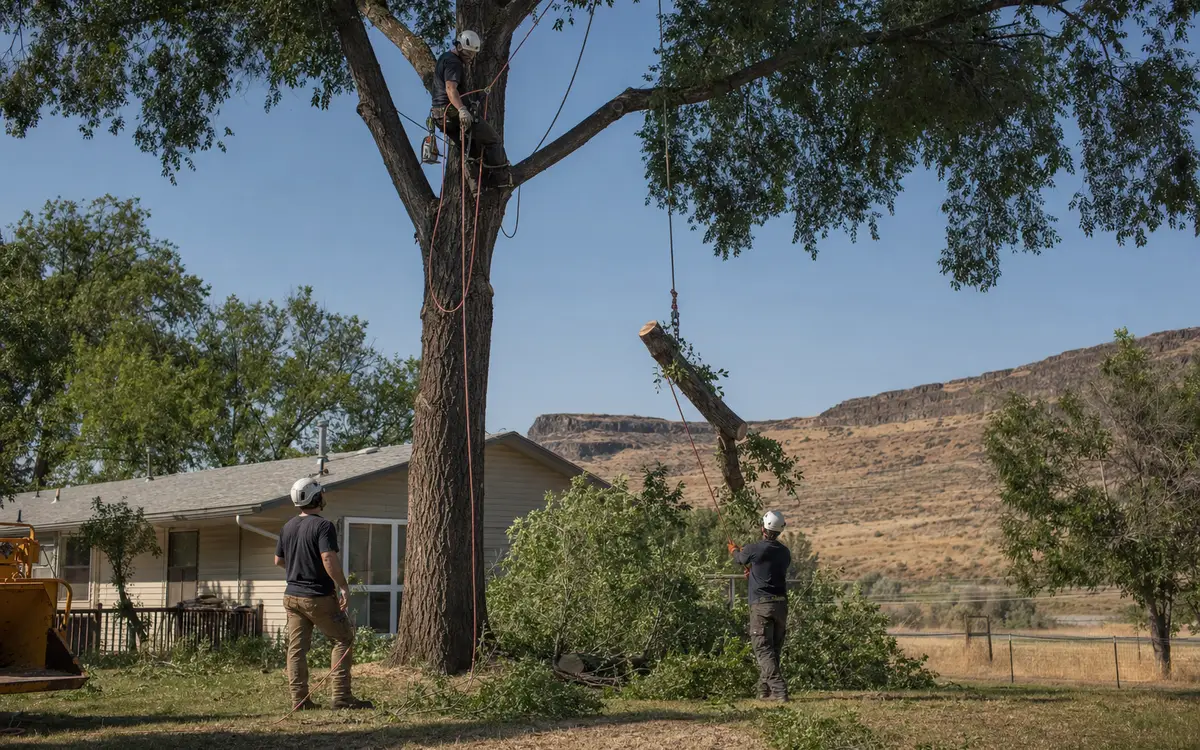
A removal starts with a site assessment: what's around the tree, how a crew can get equipment in, and whether the drop zone is clear or crowded with a fence, a shed, a driveway, or a neighbor's property line. From there, the crew decides between a straightforward felling, where the tree comes down in one controlled direction, and a rigged, section-by-section removal using ropes and a controlled lowering system when a straight drop isn't an option. A handful of removals, usually the largest trunks in the tightest spaces, call for a crane to lift sections out cleanly instead of lowering them by rope. Cleanup follows the cut work: limbs and brush get chipped or hauled, and the trunk gets bucked into rounds or hauled off whole depending on what you'd like done with the wood. Stump grinding is a separate step, not automatically included, so ask about it directly if you want the stump gone along with the tree; see the stump grinding page for how that part works.
Removal on Steep or Difficult Lots
Not every lot in this valley is flat. Properties on Normal Hill, the Lewiston Orchards bench, and similar elevated terrain often put a tree on a slope steep enough that a straight drop simply isn't safe or possible. Rigging on a slope means extra anchor points, more careful route planning for hauling debris out, and often more time on site than the same tree would take on level ground. Canyon bluff lots add their own wrinkle: basalt outcrops and thin soil that change how a root system anchors a tree in the first place, which affects both the removal plan and how stable the remaining slope is once the tree is gone. See the hillside tree removal page for a fuller look at how this terrain-specific work is planned.
Storm and Hazard Removal
Wind and heavy wet snow bring trees down in this valley most winters, and a storm-damaged tree often needs a different kind of assessment than a routine removal. A split trunk or a tree leaning against a structure after a storm carries its own hazard on top of the original problem, and the priority shifts to making the situation safe before anything else. Fallen limbs tangled with power lines need extra caution, and a tree still standing but visibly compromised after a storm is often more dangerous than one that has already come down, since it can fail again with no warning. See the storm damage page for what to do first if a tree has come down on your property and how insurance documentation support works.
Licensed Across Two States
Idaho and Washington regulate tree removal differently, and this valley sits squarely on both sides of that line. Washington is explicit about it: RCW 18.27.010 defines a "contractor" to include anyone performing tree removal services, and the state's Department of Labor and Industries lists tree removal among its regulated specialty categories, requiring a $15,000 bond and liability coverage of $200,000 per occurrence and $50,000 in property damage, or $250,000 combined, before a crew can legally advertise or work anywhere in Washington, including Asotin County and Clarkston. Idaho takes a broader approach: the Idaho Contractor Registration Act requires registration for construction jobs over $2,000 and $300,000 in general liability insurance once registered, but its exemption list does not explicitly name tree service one way or the other, a genuine gray area rather than a mirrored version of Washington's rule. Practically, that means a crew working a Clarkston property needs to meet a specific, named Washington bonding and insurance standard that doesn't have an identical Idaho counterpart across the river in Lewiston. Lewiston Tree Pros connects property owners with crews that carry the coverage appropriate to whichever side of the state line the job is on, rather than treating both states as interchangeable. This is general information, not legal advice.
Common Questions
What does tree removal cost in Lewiston ID?
National cost guides put most residential tree removals at $400 to $1,450, with averages clustering around $630 to $900. Exact pricing depends on tree size, how easy the crew can access the site, whether rigging or a crane is required, and how much debris needs to be hauled away afterward.
How big does a tree need to be to cost around $1,000 to remove?
Cost tracks size, access, and rigging difficulty more than trunk height alone. A mid-size tree crowded against a fence, power line, or roof in a tight side yard can cost as much to remove as a much larger tree standing alone in an open, easy-to-reach yard, since rigging and careful lowering take more time than a straightforward drop.
Do you remove trees on steep hillside or bluff lots?
Yes. Crews connected through Lewiston Tree Pros handle removals on steep hillside and canyon bluff lots around Normal Hill, the Lewiston Orchards bench, and similar terrain, using extra anchor points and controlled lowering techniques that flat-ground removals do not require. See the hillside tree removal page for more detail on how that terrain-specific work is planned and priced.
What happens to the wood and debris?
Standard removal pricing includes hauling debris away from the site once the work is finished. If firewood-length rounds are useful to you, ask the crew to leave them stacked on request instead of hauling everything off; most crews are glad to leave usable wood behind rather than truck it away for no reason, provided you flag it before work starts.
Is tree removal regulated the same in Idaho and Washington?
No. Washington's RCW 18.27 explicitly names tree removal as regulated contractor work, requiring registration and bonding before a crew can legally work anywhere in the state, including Asotin County and Clarkston. Idaho regulates contractors through the broader Contractor Registration Act, which does not separately call out tree work, a genuine asymmetry between the two states.
Do you handle tree removal in Clarkston and Asotin?
Yes. Tree removal Lewiston ID is the Idaho-side work. Clarkston and Asotin sit a few minutes across the Snake in Washington, and those jobs need a crew that meets Washington's RCW 18.27 contractor rules, not an Idaho-only setup. We connect you with licensed crews for whichever side of the river the tree is on.
Ready to get a tree removed?
Send details through the quote form and we'll connect you with an independent local contractor.