

Hillside, Bluff & Orchard Tree Removal in Lewiston, ID
Lewiston Tree Pros connects property owners with crews experienced in hillside tree removal, canyon bluff access, old orchard tree care, and fire-season prep across Lewiston, ID.
Tree Work on Steep Lots and Canyon Bluffs
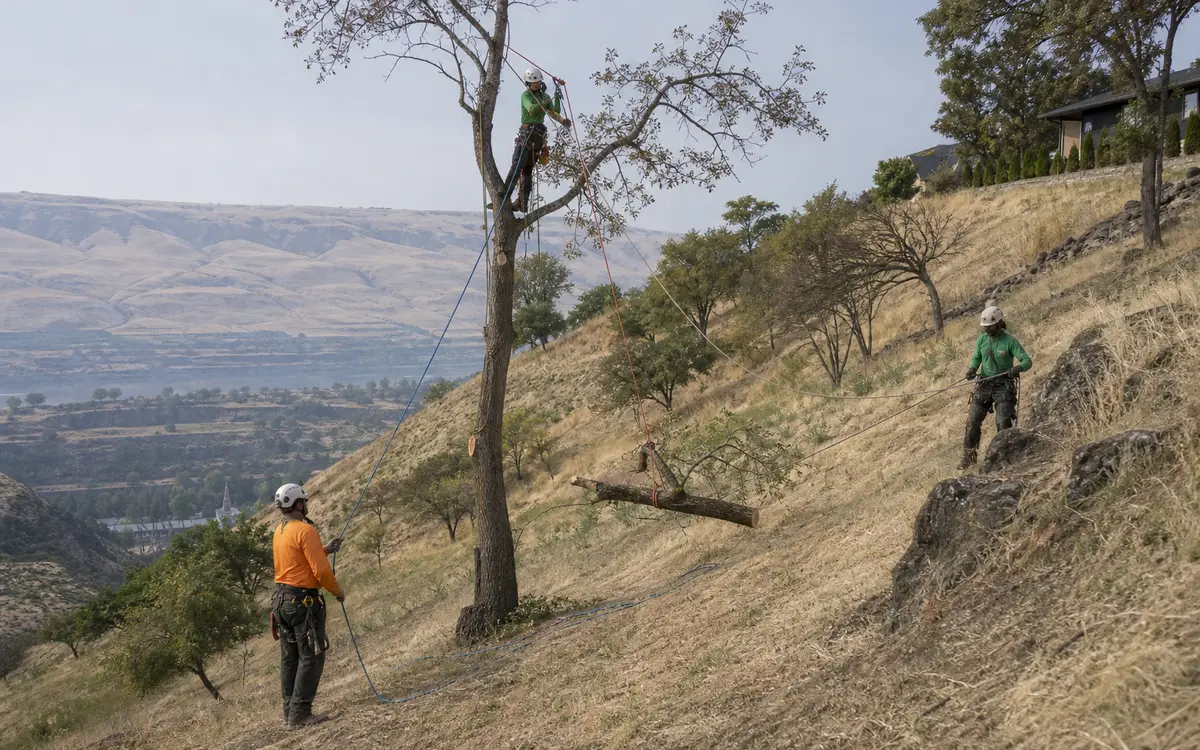
Lewiston isn't a flat river-bottom town from edge to edge. US-95 climbs the Lewiston Hill Grade, the old Spiral Highway, from around 740 feet at the valley floor to a summit near 2,756 feet, roughly 2,000 feet of elevation gain in a short distance, and neighborhoods like Normal Hill and the Lewiston Orchards bench sit genuinely elevated above downtown, not just gently sloped. A tree growing on that kind of grade changes the whole removal plan. Straight drops that work on flat ground aren't always safe or even possible on a steep bank, so crews plan extra anchor points, controlled lowering along a specific route, and a debris-hauling path that accounts for the slope rather than assuming a flatbed truck can pull right up to the base of the tree. Basalt outcrops common on the canyon walls around the valley add another variable: thin, rocky soil anchors roots differently than the deeper alluvial ground on the valley floor, which affects both how stable a tree is to begin with and how the surrounding slope behaves once a large root system is gone. None of this is exotic work, but it does take more planning than a routine backyard removal.
Old Orchard and Fruit Trees on the Lewiston Orchards Bench
The Lewiston Orchards bench earned its name honestly. The area was developed as an irrigated orchard and horticultural district under the federal Lewiston Orchards Project, and "the Orchards" remains the neighborhood's common local name today, not a marketing invention. Many of the original fruit trees planted during that era have aged out over the decades since, and declining or storm-damaged orchard trees are a genuine, recurring removal call on the bench rather than an occasional oddity. Older fruit trees often carry different failure patterns than typical ornamental shade trees: co-dominant trunks from decades of pruning for fruit production rather than structure, and rootstock that can behave differently once the trunk above it is gone. Some orchard-era rootstock is persistent enough to send up occasional root suckers well after a stump has been ground, which is a normal follow-up rather than a sign anything went wrong. See the stump grinding page for more on what typically happens once an old orchard tree comes down and the stump needs to go too.
Defensible Space and Fire-Season Prep
Lewiston sits at roughly 738 to 741 feet elevation, close to the lowest point in Idaho, and that low elevation brings a semi-arid climate with real fire-season stakes: a July average near 76 degrees, about 42 days a year at 90 degrees or higher, and roughly a week each summer at 100 degrees or above. Idaho wildfire agencies recommend defensible space in layered zones extending out to 100 feet or more from a structure, sometimes 150 to 200 feet on steeper slopes where fire moves faster and hotter uphill than across flat ground, exactly the kind of terrain found on Lewiston's canyon rims and bluff-adjacent lots. That guidance calls for removing ladder fuels and dead vegetation, keeping tree canopies spaced apart rather than touching, and keeping roughly the first five feet around a structure free of anything combustible. Crews connected through Lewiston Tree Pros can remove dead and hazard trees, thin dense stands, and clear ladder fuels as part of that defensible-space work, particularly on the steeper, more fire-exposed lots above the valley floor.
Common Questions
Can trees be safely removed on steep hillside or canyon bluff lots?
Yes, though access, rigging, and debris removal all take more planning on a slope than on flat ground. Crews typically use extra anchor points, controlled lowering, and careful route planning for hauling debris out. The terrain around Lewiston's Normal Hill and the Lewiston Orchards bench is a common, real-world example of this kind of job.
What is defensible space?
Defensible space is a buffer of thinned vegetation and reduced fuel around a home meant to slow an approaching wildfire before it reaches the structure. Idaho wildfire agencies recommend zones extending out to 100 feet or more from a home, sometimes 150 to 200 feet on steeper slopes, since fire moves faster and hotter uphill than across flat ground.
Do you remove old orchard or fruit trees from the Lewiston Orchards area?
Yes. Declining or storm-damaged fruit trees from the area's original orchard plantings on the Lewiston Orchards bench are a common local job, since many of those trees have aged out over the decades since the district was first developed as irrigated orchard ground. See the stump grinding page for what typically follows once an old orchard tree comes down.
Is fire season really a concern for tree work here?
Yes. Lewiston sits at roughly Idaho's lowest elevation with a semi-arid climate that regularly sees summer highs in the 90s and sometimes above 100 degrees, dry conditions that raise wildfire risk across the valley each year. Dead wood and overgrown vegetation left standing through a hot, dry summer add real fuel to that risk, not just a cosmetic yard problem.
Have a tree on a steep lot or an old orchard stand?
Request a free quote and we'll connect you with an independent local contractor.